


WELCOME, FUTURE APPRENTICE EMPLOYER!
ARE YOU LOOKING FOR A LOW COST OR FREE WAY TO TRAIN AND DEVELOP CURRENT EMPLOYEES OR NEW TALENT UTILISING THE UK GOVERNMENT’S APPRENTICESHIP FUND?
CEF IS DEVELOPING 20+ APPRENTICESHIP TRAINING PROGRAMMES COVERING ALL ASPECTS OF THE EVENT LIFECYCLE - FROM PLANNING, PRODUCTION, PROJECT MANAGEMENT AND PEOPLE DEVELOPMENT, TO EXECUTION AND EVALUATION.
UPON COMPLETION, APPRENTICES RECEIVE A NATIONALLY RECOGNISED QUALIFICATION (LEVEL 2-7 - GCSE, A-LEVEL, HNC, HND, DEGREE AND MASTERS LEVEL), AND ONE OF CEF’S PROFESSIONAL RECOGNITION FELLOWSHIPS FOR FREE.

BENEFITS OF WORKING WITH CEF
-
Utilising the UK apprenticeship system, in most cases, employers contribute only a small proportion of the programme cost, with the government funding at least 95% of the training and, for smaller organisations or eligible learners, up to 100%. This makes apprenticeships a highly accessible route to professional development without placing pressure on organisational budgets.
Apprenticeships enable employees to gain recognised qualifications while remaining in their roles. Learning is integrated into everyday practice, allowing staff to apply new knowledge immediately to their work. For employers, this means skills development is directly aligned with organisational needs rather than generic external training. For example, a venue operations coordinator undertaking an apprenticeship can develop expertise in risk management, customer experience, and operational planning while continuing to support live delivery.
The model therefore differs from traditional training courses. Instead of short-term attendance-based learning, apprenticeships provide structured, long-term development with mentoring, assessment, and measurable outcomes. Employers benefit from improved staff capability, retention, and succession planning, while employees gain clear progression routes and nationally recognised credentials.
In practical terms, apprenticeships allow organisations to professionalise roles, strengthen operational consistency, and invest in people at minimal cost — often no cost at all — making them one of the most cost-effective workforce development options currently available in the UK.
-
Apprenticeships provide a structured way to invest in people across your entire organisation, not only new entrants. They support development at multiple career stages, from early-career staff building foundational skills through to experienced managers strengthening leadership, strategic planning, and decision-making capability. This allows workforce development to be planned rather than reactive.
The approach is also adaptable to a wide range of roles. Operational staff, supervisors, administrators, coordinators, and senior leaders can all undertake programmes aligned to their responsibilities. Training is contextualised to the employee’s day-to-day work, ensuring learning is relevant and immediately applicable. For instance, a front-of-house supervisor can enhance customer experience management and team leadership, while a senior manager may focus on governance, financial oversight, and organisational strategy.
Because apprenticeships are embedded within employment, organisations are not sending individuals away to learn generic theory. Instead, capability is developed directly within the workplace, improving performance, confidence, and consistency across teams. Over time, this supports stronger internal progression pathways and reduces reliance on external recruitment.
In effect, apprenticeships allow organisations to build a coherent skills pipeline — developing new talent, strengthening mid-level capability, and preparing future leaders — while ensuring that professional development is accessible across diverse roles rather than limited to a single department or career stage.
-
Apprenticeships are a practical tool for both attracting new employees and retaining the people you already have. They signal that an organisation is willing to invest in development, progression, and long-term careers rather than short-term employment. For prospective applicants, particularly those entering the sector or changing careers, the opportunity to earn while gaining a recognised qualification makes roles more accessible and competitive.
For existing staff, apprenticeships provide a clear pathway for progression. Employees can see how their role connects to future opportunities, which increases motivation and commitment. Structured learning, mentoring, and recognised achievement help individuals feel valued and supported. For example, an events assistant who can progress into a coordinator or managerial role through an apprenticeship is far more likely to remain within the organisation than seek advancement elsewhere.
Retention is not only about pay; it is closely linked to development and recognition. Staff who feel their skills are growing and their contribution is acknowledged are less likely to leave. Apprenticeships formalise this process by creating agreed development plans and measurable outcomes, giving employees confidence that their career is moving forward.
Over time, this reduces recruitment costs, preserves organisational knowledge, and improves team stability. Instead of repeatedly replacing staff, organisations build experienced teams who understand their culture, operations, and stakeholders — strengthening both performance and continuity.
-
Recruiting a new apprentice allows your organisation to actively shape its future workforce. Rather than relying solely on an increasingly competitive labour market, you can develop individuals from the outset, embedding the skills, behaviours, and standards that your organisation requires. Apprentices learn within your working environment, meaning their training is directly relevant to your operations from day one.
New apprentices bring fresh perspectives, digital confidence, and a willingness to learn, while structured training ensures they build professional capability alongside practical experience. For example, a newly recruited apprentice supporting event delivery can develop competence in planning, communication, and customer service while contributing to real projects under supervision. Over time, they grow into reliable team members who understand your procedures, stakeholders, and organisational culture.
This approach creates a sustainable talent pipeline. As apprentices progress, they can move into permanent roles, reducing dependence on external recruitment and minimising onboarding time. Organisations benefit from continuity, while individuals gain meaningful career entry points and recognised qualifications.
In effect, hiring an apprentice is not simply filling a vacancy; it is a long-term workforce strategy that develops committed employees, strengthens organisational capacity, and ensures the next generation of talent is prepared specifically for your needs.
-
The Centre for Events and Festivals (CEF) supports employers at every stage of the apprenticeship journey, reducing administrative burden and providing clear guidance. From the initial discussion about organisational needs through to enrolment and completion, employers are not expected to navigate the system alone. CEF helps identify suitable apprenticeship standards, explains funding arrangements, and supports workforce planning so that training aligns with operational priorities.
During delivery, CEF works alongside both the employer and the apprentice. This includes coordinating enrolment, monitoring progress, supporting workplace mentors, and ensuring the required off-the-job learning is manageable within normal working patterns. Regular reviews help track development and address any challenges early, allowing the programme to remain practical rather than disruptive to day-to-day operations. For example, review meetings can link an apprentice’s learning directly to upcoming projects or operational responsibilities.
CEF also prepares employers and apprentices for final assessment and completion, ensuring expectations are clear and documentation is in place. The emphasis is on a structured yet supportive process that maintains quality while remaining straightforward to manage.
Overall, the aim is to make apprenticeships easy to implement and valuable in practice. Employers gain a dedicated partner who manages complexity, supports staff development, and helps ensure the training delivers meaningful outcomes for both the organisation and the employee.
-
Hiring an apprentice removes many of the typical costs associated with recruitment. Organisations can bring in new staff without paying agency fees, advertising expenses, or extensive onboarding costs. The apprenticeship system supports the recruitment process, helping employers identify suitable candidates and ensuring they meet eligibility requirements before employment begins.
Because training is built into the programme, new hires develop the required skills as part of their role rather than requiring separate external courses. Induction, mentoring, and structured learning are integrated, meaning organisations are not paying additional providers to deliver foundational training. For example, instead of recruiting an experienced coordinator at a premium salary, an employer can appoint an apprentice and support them to reach competence through supervised work and guided learning.
This approach lowers the financial risk of expanding a team while still allowing organisations to increase capacity. Employers gain a motivated employee who is developing role-specific skills, and the individual gains a recognised qualification and career entry point.
In practice, apprenticeships enable organisations to grow their workforce in a planned and cost-effective way — investing in capability without the significant upfront recruitment expenditure normally associated with hiring new staff.
-
Apprentices are employees from their first day of work and must therefore be paid through your normal payroll processes. Employers are required to pay at least the statutory apprentice minimum wage, although many organisations choose to pay above this rate to remain competitive and support recruitment and retention.
The current legal minimum rates are:
£6.40 per hour for apprentices aged under 19, or those aged 19+ in the first year of their apprenticeship
After the first year, apprentices aged 19 or over must be paid the age-appropriate National Minimum Wage:
18–20 years: £8.60 per hour
21+ years (National Living Wage): £11.44 per hour
You cannot pay below these legal minimums, but you may choose to offer higher pay in line with your organisation’s salary structure.
Apprentices are paid for all contracted working hours, including their off-the-job training. Around 20% of their working time is dedicated to structured learning, mentoring, and development activities, and this is fully paid time rather than unpaid study. In practice, this means the apprentice remains an employee while training, and their learning forms part of their normal working week rather than sitting outside it.
Overall, apprenticeships operate like standard employment: the apprentice receives a salary, gains practical experience, and develops professionally, while you benefit from a member of staff contributing to day-to-day operations as they learn.
-
All apprenticeship training and development is designed and delivered by recognised subject specialists, including experienced practitioners and university professors. This ensures programmes are informed by both current industry practice and established research, rather than generic training materials. Content is regularly updated to reflect changing regulations, technologies, and professional standards.
Teaching combines academic understanding with applied learning. Participants do not only learn what to do, but why practices work and how they can be improved. For example, topics such as risk management, stakeholder engagement, and operational planning are explored through real-world scenarios and structured reflection linked directly to workplace responsibilities.
Employers therefore gain staff who are developing informed judgement, not simply completing tasks. Employees benefit from credible qualifications and structured professional development grounded in recognised expertise.
The result is training that supports immediate workplace performance while also building longer-term professional capability and career progression.
-
On completion of an apprenticeship, participants achieve a nationally recognised qualification, ranging from Level 2 through to Level 7. These levels correspond broadly to GCSE, A-Level, higher education, and postgraduate study, providing clear progression routes from entry-level roles to senior leadership development.
The qualification is awarded following an independent end-point assessment, ensuring that competence has been demonstrated in practice as well as through knowledge. Apprentices therefore graduate having applied their learning in real workplace situations, rather than through classroom study alone. For example, a manager completing a higher-level apprenticeship may evidence leadership, planning, and decision-making through projects undertaken within their organisation.
For employers, this provides assurance that staff have met nationally defined occupational standards. For employees, the qualification is portable and formally recognised across sectors, supporting career mobility and progression.
Apprenticeships therefore combine practical experience with credible accreditation, enabling individuals to gain qualifications from foundational to master’s level while remaining in employment.
-
In addition to their qualification, apprentices receive professional recognition through the Centre for Events and Festivals (CEF). Successful completion leads to an appropriate level of CEF membership and the award of post-nominal letters, reflecting their capability and professional standing within the sector.
Recognition is aligned to experience and responsibility, ranging from Associate Fellow through to Fellow, Senior Fellow, National Fellow, and International Fellow. This provides a clear professional identity and a visible marker of competence that can be used in professional communications, reports, and career progression.
For employers, this offers assurance that staff are not only trained but formally recognised against sector standards. For individuals, it strengthens credibility and supports long-term career development. For example, a supervisor completing an apprenticeship may achieve Associate Fellow recognition, while a senior leader undertaking a higher-level programme may be recognised at a more advanced fellowship level.
The process therefore links training to professional status, helping build a recognised community of qualified practitioners and reinforcing standards across the sector.
-
All apprentices become part of the Centre for Events and Festivals (CEF) alumni community upon completion of their programme. This provides ongoing connection beyond the training period, enabling individuals to remain engaged with peers, industry developments, and professional practice.
Alumni are invited to networking events, meet-ups, and knowledge-sharing sessions that encourage continued learning and collaboration. These activities allow participants to exchange experiences, discuss challenges, and learn from practitioners working in different organisations and roles. For example, a graduate working in venue operations may gain insight from peers involved in festivals, cultural programming, or major sporting events.
For employers, this extended network supports staff development beyond formal training and exposes employees to new ideas and approaches that can be applied within the organisation. For individuals, it offers a professional community that supports career progression, mentoring opportunities, and continuing professional development.
The alumni network therefore ensures apprenticeships are not a one-off intervention but the beginning of a longer-term professional relationship and learning journey.
-
Both apprentices and participating employers are eligible for recognition through the Centre for Events and Festivals (CEF) annual Golden Ticket Awards. Outstanding individuals can be nominated for ‘Apprentice of the Year’, while organisations demonstrating strong commitment to development and support can be recognised through the ‘Apprenticeship of the Year’ award.
The awards celebrate achievement in practice, highlighting how learning has been applied within real workplace contexts. Nominations typically recognise progress, innovation, leadership, and contribution to organisational performance. For example, an apprentice who has led improvements to customer experience processes, or an employer who has embedded structured mentoring and progression pathways, may be put forward for consideration.
For organisations, this offers positive external recognition and an opportunity to showcase investment in people and professional standards. For apprentices, it provides formal acknowledgement of their effort and capability at an early stage of their career.
The awards therefore reinforce the value of apprenticeships by recognising excellence, encouraging high standards, and celebrating successful development across the sector.
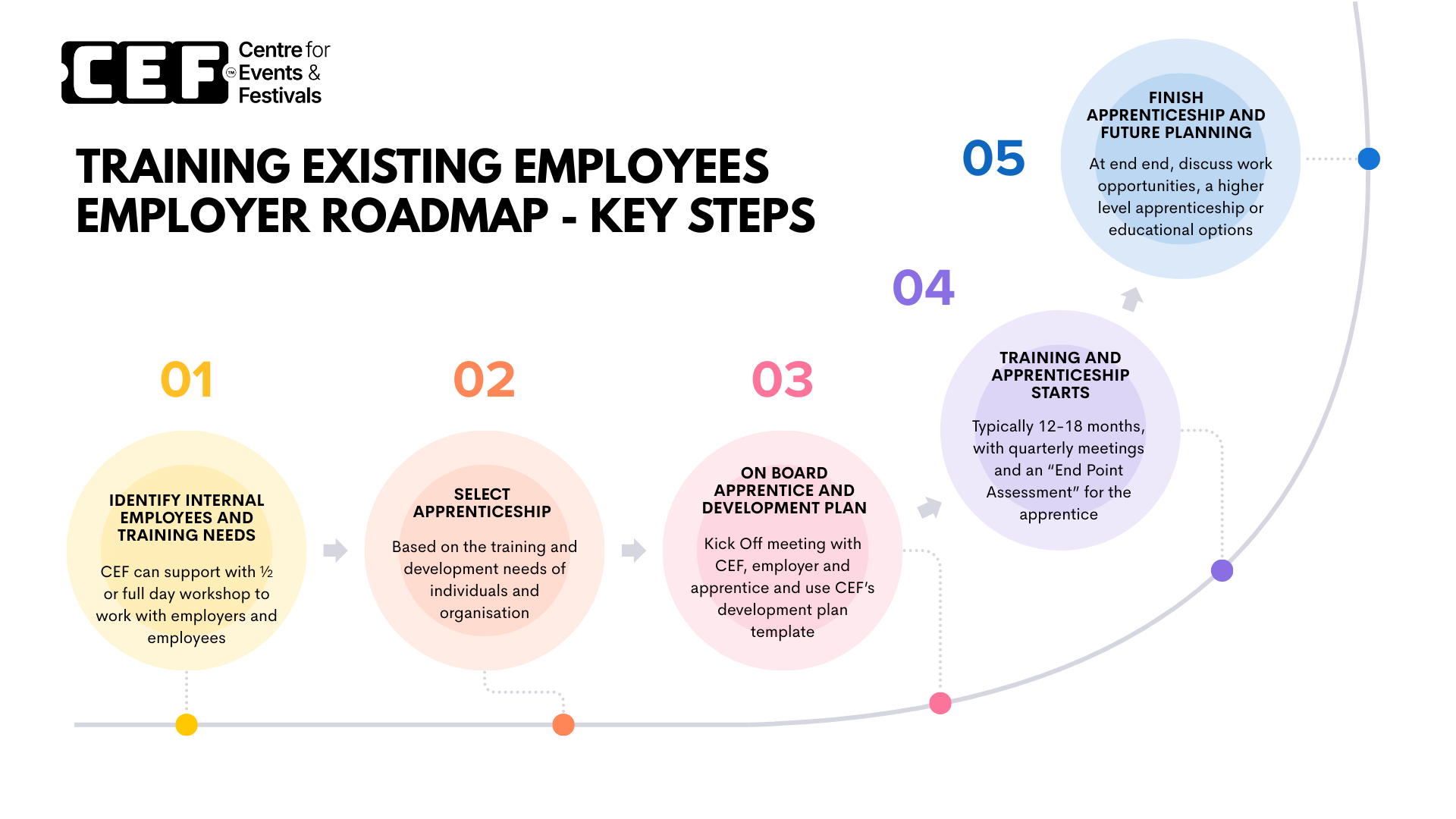
KEY STEPS FOR TRAINING EXISTING EMPLOYEES
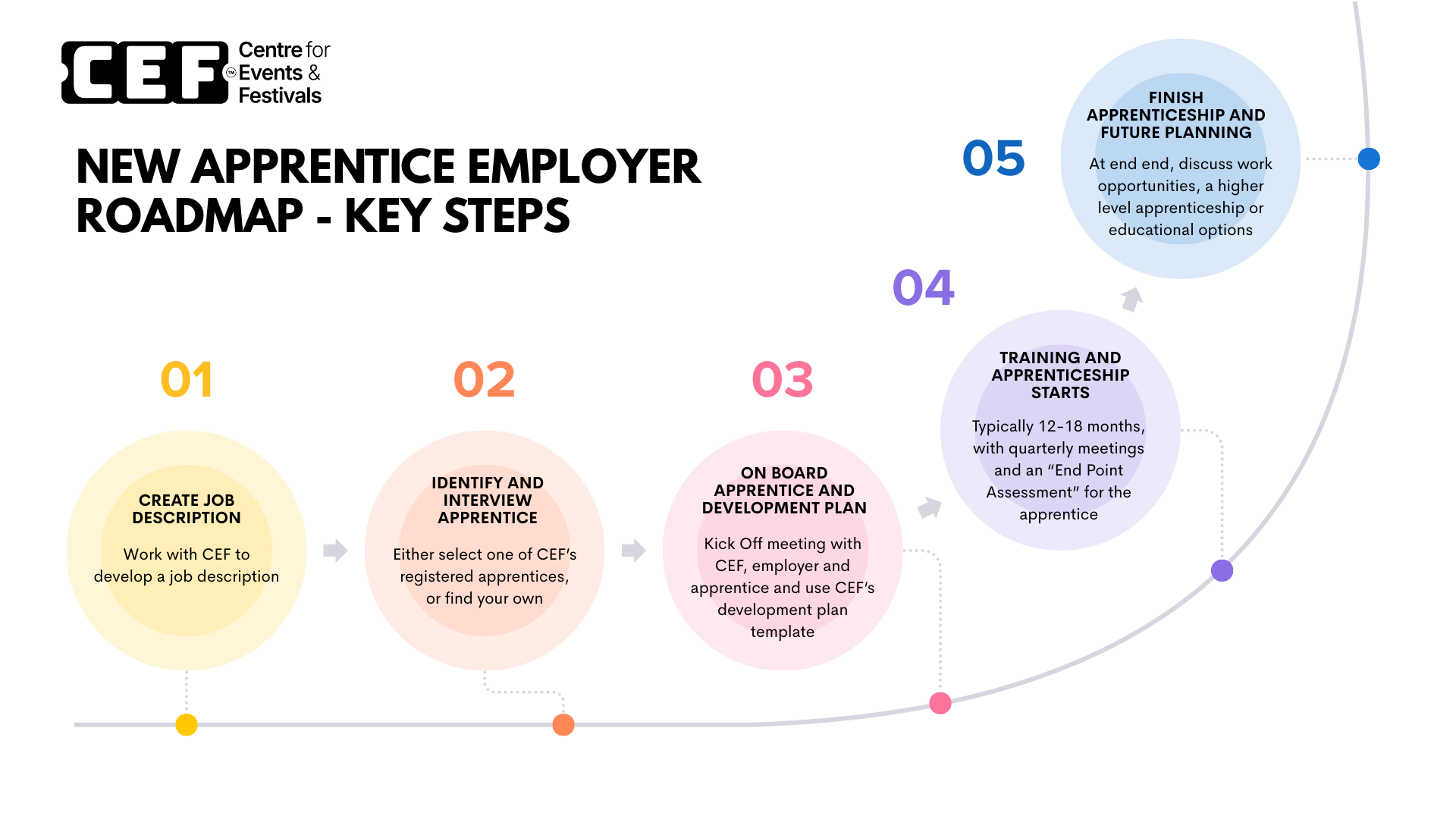
KEY STEPS FOR HIRING A NEW APPRENTICE
Sample CEF apprentice overview for Events Assistant (Level 3)

SEARCH BY LEVEL (2-7) FOR
ALL AVAILABLE APPRENTICESHIPS
WHAT LEVEL 2 AND 3 APPRENTICESHIPS ARE AVAILABLE?
Level 2 apprenticeships are equivalent to GSCE standard.
Level 3 apprenticeships are equivalent to A-Level standard.
-
Working in an events company or events department in an organisation, helping event planners and project managers to organise and host events.
https://findapprenticeshiptraining.apprenticeships.education.gov.uk/courses/159
-
To prepare, build, set up, and operate functioning systems for creative productions.
https://findapprenticeshiptraining.apprenticeships.education.gov.uk/courses/721
-
Working across various business teams to bring together compelling, customer focused proposals and tender submissions to win business.
https://findapprenticeshiptraining.apprenticeships.education.gov.uk/courses/400
-
Helping to shape, support and deliver marketing plans, working in conjunction with the Marketing Manager.
https://findapprenticeshiptraining.apprenticeships.education.gov.uk/courses/480
-
Support customer focussed marketing activities that drive the demand for a product or service.
https://findapprenticeshiptraining.apprenticeships.education.gov.uk/courses/737
-
Supporting and engaging with different parts of the organisation and interact with internal or external customers.
https://findapprenticeshiptraining.apprenticeships.education.gov.uk/courses/196
-
Dealing with customer queries, purchases and complaints.
https://findapprenticeshiptraining.apprenticeships.education.gov.uk/courses/278
-
Managing individuals, teams, or projects to meet private, public, or voluntary organisational goals.
https://findapprenticeshiptraining.apprenticeships.education.gov.uk/courses/105
-
Working with management and delivery teams to advise on the statutory health, safety and environmental requirements.
https://findapprenticeshiptraining.apprenticeships.education.gov.uk/courses/260
-
Supervising staff and activities within hospitality businesses including bars, cafes, conference centres, restaurants and hotels.
https://findapprenticeshiptraining.apprenticeships.education.gov.uk/courses/138
-
Responsible for delivery and coaching of improvement activity within an area of responsibility.
https://findapprenticeshiptraining.apprenticeships.education.gov.uk/courses/238
-
The process of procurement or buying low value goods and services.
https://findapprenticeshiptraining.apprenticeships.education.gov.uk/courses/590
-
Provide support in financial services, ensuring smooth operations, regulatory compliance, and excellent customer service.
https://findapprenticeshiptraining.apprenticeships.education.gov.uk/courses/8
-
To be an organisation’s first line of defence.
https://findapprenticeshiptraining.apprenticeships.education.gov.uk/courses/716
-
Providing facilities services support to customers and facilities management departments.
https://findapprenticeshiptraining.apprenticeships.education.gov.uk/courses/440
-
Managing the movement of goods across all sectors and distances for a range of customers from private individuals and sole traders through to large global organisations.
https://findapprenticeshiptraining.apprenticeships.education.gov.uk/courses/109
-
Hospitality Accommodation Team Member is a multi-skilled occupation in dining and bar, guest services and housekeeping.
https://findapprenticeshiptraining.apprenticeships.education.gov.uk/courses/804
-
Providing customer service products and services for businesses and other organisations including face-to-face, telephone, digital and written contact and communications.
https://findapprenticeshiptraining.apprenticeships.education.gov.uk/courses/122
WHAT LEVEL 4 AND 5 APPRENTICESHIPS ARE AVAILABLE?
Level 4 apprenticeships are equivalent to Higher National Certificate (HNC) standard.
Level 5 apprenticeships are equivalent to Higher National Diploma (HND).
-
Helping to shape, support and deliver marketing plans, working in conjunction with the Marketing Manager.
https://findapprenticeshiptraining.apprenticeships.education.gov.uk/courses/349
-
Working across a variety of organisations focusing on ensuring excellent customer experience.
https://findapprenticeshiptraining.apprenticeships.education.gov.uk/courses/223
-
Working as an accountant for an accounting practice or other organisation.
https://findapprenticeshiptraining.apprenticeships.education.gov.uk/courses/117
-
Identify and lead the delivery of change across organisational functions and processes.
https://findapprenticeshiptraining.apprenticeships.education.gov.uk/courses/237
-
Buying the goods and services that enable an organisation to operate.
https://findapprenticeshiptraining.apprenticeships.education.gov.uk/courses/222
-
Making sure that buildings and their services meet the needs of the people that work in them.
https://findapprenticeshiptraining.apprenticeships.education.gov.uk/courses/266
-
Governance officers provide administrative and operational support.
https://findapprenticeshiptraining.apprenticeships.education.gov.uk/courses/710
-
Collect, organise and study data to provide business insight.
https://findapprenticeshiptraining.apprenticeships.education.gov.uk/courses/80
-
Managing project work and teams for businesses and other organisations.
https://findapprenticeshiptraining.apprenticeships.education.gov.uk/courses/128
-
Leading end-to-end sales interaction with customers and managing sales internally within an organisation.
https://findapprenticeshiptraining.apprenticeships.education.gov.uk/courses/369
-
Support the delivery and management of critical information, whether digital or otherwise, in the (capital) delivery phase of an infrastructure project and the ongoing management of that information within the operational phase of the resulting asset.
https://findapprenticeshiptraining.apprenticeships.education.gov.uk/courses/540
-
Identifying, designing, and delivering practical improvements in how work gets done across business functions, using AI and automation.
https://findapprenticeshiptraining.apprenticeships.education.gov.uk/courses/828
-
Providing People Professional expertise within a company or organisation.
https://findapprenticeshiptraining.apprenticeships.education.gov.uk/courses/190
-
Work with individuals and teams to enhance their professional performance.
https://findapprenticeshiptraining.apprenticeships.education.gov.uk/courses/555
-
Providing People Professional expertise within a company or organisation.
https://findapprenticeshiptraining.apprenticeships.education.gov.uk/courses/190
-
Leading the deployment of improvement strategies.
https://findapprenticeshiptraining.apprenticeships.education.gov.uk/courses/375
-
Managing teams and projects in line with a private, public, or voluntary organisation's operational or departmental strategy.
https://findapprenticeshiptraining.apprenticeships.education.gov.uk/courses/104
WHAT LEVEL 6 AND 7 APPRENTICESHIPS ARE AVAILABLE?
Level 6 apprenticeships are equivalent to Degree standard.
Level 7 apprenticeships are equivalent of Masters standard.
-
Responsible for the marketing activities and strategy of their organisation.
https://findapprenticeshiptraining.apprenticeships.education.gov.uk/courses/348
-
Set the procurement and supply chain strategy.
https://findapprenticeshiptraining.apprenticeships.education.gov.uk/courses/732
-
Assisting individuals or organisations before or during career transitions to develop long and short term career strategies.
https://findapprenticeshiptraining.apprenticeships.education.gov.uk/courses/453
-
Ensure that projects deliver successfully and safely to time, cost and quality.
https://findapprenticeshiptraining.apprenticeships.education.gov.uk/courses/651
-
A leader who has senior management responsibility.
https://findapprenticeshiptraining.apprenticeships.education.gov.uk/courses/236
-
Improve people practices in organisations in order to drive organisational performance and effectiveness.
https://findapprenticeshiptraining.apprenticeships.education.gov.uk/courses/615
-
Takes responsibility for all the organisational aspects of production schedule and/or budget.
https://findapprenticeshiptraining.apprenticeships.education.gov.uk/courses/528
-
Help clients (either internally or externally) to make strategic, tactical and operational decisions.
https://findapprenticeshiptraining.apprenticeships.education.gov.uk/courses/600
-
Providing independent, objective assurance and consulting activity to add value and improve an organisation's operations.
https://findapprenticeshiptraining.apprenticeships.education.gov.uk/courses/324